I have been discussing with colleagues recently what we mean by ‘sustainable places’. I have always thought of sustainability as multifaceted, spanning environmental, social and economic domains. However, perhaps because of the recent and justified focus on our changing climate [2], the environmental aspect is often the first thing people think of, and my conversations are dominated by environmental metrics: CO2 emissions, biodiversity and energy use.
These are important components of the larger picture, but they are insufficient in isolation as a basis for judging whether a place is sustainable. A place that performs well on environmental indicators but has poor community cohesion, a weak local economy, or poor health outcomes is failing in several of the dimensions that make it a good place to live. ‘Left-behind’ places, for example post-industrial and coastal towns in the United Kingdom [10], illustrate this problem clearly. Environmental metrics may say little about the experience of communities where economic disinvestment has eroded social ties, cultural institutions have closed, and health outcomes have diverged sharply from those of more prosperous areas.
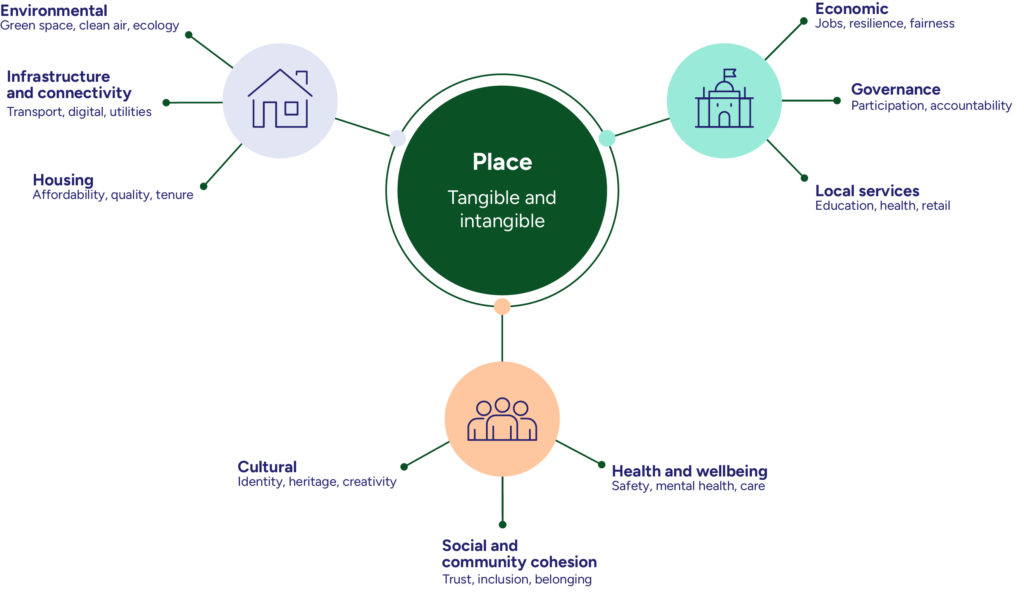
This blog makes the case for a nine-dimensional framework for defining the sustainability of a place, one that goes beyond environmental metrics. The nine dimensions are:
(1) environmental;
(2) social and community cohesion;
(3) economic;
(4) cultural;
(5) governance;
(6) health and wellbeing;
(7) infrastructure and connectivity;
(8) local services; and
(9) housing.
The blog draws on well-established ideas about the multifaceted nature of sustainability, places them in a HASP context, and argues that sustainable places need to be successful across multiple domains.
Background
The concept of sustainable development was popularised in international policy discourse through the 1987 Brundtland Report Our Common Future, which defined it as development that ‘meets the needs of the present without compromising the ability of future generations to meet their own needs’. The subsequent operationalisation of sustainability tended to concentrate on the environmental dimension (climate, ecology and resource use), with social, economic and cultural factors treated as secondary. More detailed consideration of what the social and other dimensions of sustainability entail emerged in the early 2000s.
The 2004 Egan Review, Skills for Sustainable Communities, went beyond environmental sustainability, defining seven domains (governance; transport and connectivity; services; environmental; economy; housing and the built environment; social and cultural). Subsequently, the Bristol Accord of 2005 proposed a different definition across eight domains (active, inclusive and safe; well run; environmentally sensitive; well designed and built; well connected; thriving; well served; fair for everyone). Even so, researchers argue that there is still work to do in defining the social dimensions of sustainability [1, 13], relative to the maturity of the environmental dimension.
These definitions lay the groundwork upon which HASP builds, in line with our mission to better understand the intersection of health and sustainability in the places where people live. This is a timely exercise: we want to ensure we are defining and measuring the right things, and ultimately collating the right data assets to support researchers via the data service. A more complete assessment of what makes places sustainable is needed.
A Multidimensional Framework for Sustainable Places
Place sits at the heart of the framework presented below. Place is both a tangible and an intangible entity, and it needs to be understood across all nine sustainability domains. It can be measured by boundaries, but it also represents the complex social and emotional ties that shape how people feel about, and interact with, the places where they live. Each of the nine dimensions is substantive in its own right; all are necessary conditions for a place to be considered sustainable, and they are interdependent.
Dimension 1: Environmental sustainability
As one of nine, the environmental dimension remains essential. Urban green infrastructure, clean air and water, biodiversity, and climate resilience provide the ecological substrate on which all human activity depends. Research has demonstrated that urban green infrastructure delivers multiple co-benefits: it regulates urban temperature, attenuates flood risk, and supports social cohesion by providing shared urban green spaces [3, 16].
Dimension 2: Social sustainability and community cohesion
Social sustainability encompasses the norms of trust, reciprocity, networks of association, and the sense of belonging that enable communities to function as collective actors. Social capital is a key driver of civic engagement, economic prosperity and community wellbeing. The absence of social cohesion leaves communities vulnerable to crisis [14] and less able to recover from systemic shocks (e.g. the Covid-19 pandemic).
Community cohesion is the degree to which residents share trust, identity, mutual obligations, and a sense of belonging. Communities with strong social capital are more resilient to shocks, more effective in managing shared natural resources, and better able to sustain participatory governance [14]. This might intangibly be called a ‘sense of place’: where people feel they belong and are bought into their community.
Dimension 3: Economic sustainability
Economic sustainability is the capacity of a local or regional economy to adapt, diversify, and recover from shocks without permanent decline. Resilient regional economies are those capable of adapting their industrial structure and institutions over time, rather than simply returning to a pre-shock equilibrium [5].
Economic inequality within a place is itself a threat to sustainability. For example, high inequality corrodes social trust and cohesion [14] and undermines health outcomes [7]. Local economic sustainability requires both growth over time and equitable distribution [11].
Dimension 4: Cultural sustainability
Cultural sustainability recognises that places have unique histories and identities. The literature suggests seven distinct storylines in the scientific discourse on cultural sustainability, ranging from culture as heritage preservation to culture as a dynamic driver of social change [6].
Places with strong cultural identities are better able to resist poor quality and detrimental development pressures, attract civic investment, and sustain the shared stories that generate community attachment. Cultural institutions such as museums, theatres, libraries and festivals serve as infrastructure for social cohesion, and they are frequently the first to be cut in times of austerity, with lasting consequences for place identity.
Dimension 5: Governance sustainability
Sustainable places require governance that is participatory and accountable. Civic engagement in local decision-making is positively associated with institutional trust and the perceived legitimacy of public decisions [8]. Without this, communities struggle to pursue any of the other sustainability dimensions collectively.
Governance sustainability extends beyond formal democratic processes. It encompasses the degree to which residents feel they have meaningful influence over decisions that affect their lives, and the degree to which institutions are transparent and responsive. Where governance is perceived as distant or corrupt, social cohesion and civic participation decline [14].
Dimension 6: Health and wellbeing sustainability
Health and wellbeing is both an outcome of the other eight dimensions and a precondition for them. Communities with poor health have reduced capacity for civic participation, economic productivity, and social engagement [7]. In parallel, weaknesses in those other dimensions cause poor health. The social determinants of health [12] are the conditions in which people are born, grow, live, work and age. These are fundamentally place-based conditions: housing quality, air quality, green space access, employment security, social connection, and safety. A sustainable place is one that creates health-enabling conditions.
Dimension 7: Infrastructure and connectivity sustainability
For a place to be sustainable, it needs to be well connected. A perfect place would become imperfect quickly if people were unable to get to and from it for work, leisure or other purposes. It would become insular and stop evolving, and the lack of access would affect other domains (e.g. economic sustainability would be threatened if people could not easily access their work). Connectivity also encapsulates digital connectivity, which is increasingly essential for day-to-day service delivery, work and leisure. Other infrastructures matter within this domain too, including reliable energy networks. Rural communities in particular are blighted by poor internet connections, power cuts, and expensive or polluting heating options, such as oil where gas networks are not available.
Dimension 8: Local services sustainability
The availability and quality of local services, such as doctors’ surgeries, shops and schools, have a direct impact on the quality of life of people living in places. Having adequate services means places are self-sustaining and people do not need to travel long distances for access. An increasing literature on 20-minute neighbourhoods [15] speaks to this domain: good availability of services means people can behave in more sustainable ways, for example walking and cycling instead of driving.
Dimension 9: Housing sustainability
Housing deserves a dimension to itself because most people spend a large proportion of their time at home. Homes need to be of a good standard, not dangerous or cold. Sustainable homes are more efficient: they save occupants money on their energy bills and reduce environmental impacts, and warm homes have a positive impact on the health and wellbeing domain. High-quality housing also speaks to the less tangible elements of place. People see their home as their safe place, and this affinity can have a strong positive effect on the social and community cohesion domain. If you are not happy in your home, you are more likely to want to leave a place.
The Interdependence of Dimensions
The nine dimensions outlined above are not independent. They form a system in which weaknesses in one dimension can accelerate deterioration in others, and strengths in one support resilience across others. For example, economic decline erodes social cohesion: when places lose employment, social ties weaken, trust in institutions falls, and outmigration accelerates. Similarly, environmental quality and community cohesion reinforce each other. Green spaces are settings for social interaction and community identity, while their absence or poor quality is associated with reduced social cohesion, especially in deprived areas [4]. At the same time, poor governance undermines all other dimensions simultaneously [8].
Health and wellbeing is the area where the relationship is most obviously bi-directional: poor health limits people’s ability to engage with the other sustainability dimensions, while the social determinants of health are largely a product of the other domains. We have work to do in measuring these overlapping domains of sustainability. One example of incremental progress towards a more holistic understanding, capturing both average outcomes and the inequality around them, is provided by the Inclusive Economy indicators held within the HASP datastore. These thirteen indicators cover segments of multiple domains and, when clustered, have been shown to be associated with distinct patterns of population health: more inclusive areas have higher life expectancy and lower lifespan inequality [11].
The Utility of Smart Data
Many of these domains can be defined and partly measured using existing and established forms of data: environmental sustainability by green space availability, social cohesion by crime rates, economic sustainability by unemployment rates, cultural sustainability by counting cultural institutions, governance sustainability by voter turnout at elections, and health and wellbeing by self-reported health outcomes derived from census data.
Smart data, however, provide opportunities in two distinct ways: (1) they enrich what we already know, filling in gaps and often providing more timely or updateable data; and (2) they provide insight into how people interact with places in ways that enhance our understanding of sustainable behaviours and practices. Examples include app and footfall data that tell us about interaction with the high street, connected vehicle data that tell us how people navigate the built environment, and detailed property information that tells us about the social composition of neighbourhoods.
It is the mission of the Healthy and Sustainable Places Data Service to progress the expanding research agenda that encapsulates the multifaceted interactions of these sustainability dimensions with the health of places. Smart data provide one of the key pillars allowing us to do this, and can be blended with other available data to form a more complete view of what makes places sustainable. I have no doubt the framework outlined in this blog will be refined as further research emerges, supported by HASP and the wider Smart Data Research UK programme.
References
[1] Ly, A.M. & Cope, M.R. (2023). New conceptual model of social sustainability: Review from past concepts and ideas. International Journal of Environmental Research and Public Health, 20(7), 5350. DOI: 10.3390/ijerph20075350
[2] Climate Change Committee (2026). A Well-Adapted UK. https://www.theccc.org.uk/publication/a-well-adapted-uk/
[3] Hanna, E. & Comín, F.A. (2021). Urban green infrastructure and sustainable development: A review. Sustainability, 13(20), 11498. DOI: 10.3390/su132011498
[4] Jennings, V., Larson, L. & Yun, J. (2016). Advancing sustainability through urban green space: Cultural ecosystem services, equity, and social determinants of health. International Journal of Environmental Research and Public Health, 13(2), 196. DOI: 10.3390/ijerph13020196
[5] Simmie, J. & Martin, R. (2010). The economic resilience of regions: Towards an evolutionary approach. Cambridge Journal of Regions, Economy and Society, 3(1), 27–43. DOI: 10.1093/cjres/rsp029
[6] Soini, K. & Birkeland, I. (2014). Exploring the scientific discourse on cultural sustainability. Geoforum, 51, 213–223. DOI: 10.1016/j.geoforum.2013.12.001
[7] Akhter, N., McGowan, V.J., Halliday, E., Popay, J., Kasim, A. & Bambra, C. (2023). Community empowerment and mental wellbeing: Longitudinal findings from a survey of people actively involved in the Big Local place-based initiative in England. Journal of Public Health, 45(2), 423–431. DOI: 10.1093/pubmed/fdac073
[8] Zientara, P., Zamojska, A. & Cirella, G.T. (2020). Participatory urban governance: Multilevel study. PLOS ONE, 15(2), e0229095. DOI: 10.1371/journal.pone.0229095
[10] Houlden, V., Robinson, C., Franklin, R., Rowe, F. & Pike, A. (2024). ‘Left behind’ neighbourhoods in England: Where they are and why they matter. The Geographical Journal, 190(4), e12583. DOI: 10.1111/geoj.12583
[11] Lomax, N., Rice, H.P., Hoehn, A., Hughes, C., Heppenstall, A., Elsenbroich, C. & Meier, P. (2026). An Inclusive Economy Classification of British Local Authority Districts and Assessment of Its Association With Life Expectancy and Lifespan Variation. Population, Space and Place, 32(1), e70151. DOI: 10.1002/psp.70151
[12] Marmot, M. (2020). Health equity in England: The Marmot Review 10 years on. BMJ, 368, m693. DOI: 10.1136/bmj.m693
[13] Åhman, H. (2013). Social sustainability – society at the intersection of development and maintenance. Local Environment, 18(10), 1153–1166. DOI: 10.1080/13549839.2013.788480
[14] Orazani, S.N., Reynolds, K.J. & Osborne, H. (2023). What works and why in interventions to strengthen social cohesion: A systematic review. Journal of Applied Social Psychology, 53(10), 938–995. DOI: 10.1111/jasp.12990
[15] Pollack, R., Olsen, J.R., Heppenstall, A., Hoehn, A., Boyd, J., Ponce Hardy, V., Littlejohn, J., Stevenson, A., Mitchell, R., Meier, P. & Stokes, J. (2024). How could 20-minute neighbourhoods impact health and health inequalities? A policy scoping review. BMC Public Health, 24(1), 3426. DOI: 10.1186/s12889-024-20928-5
[16] Jennings, V. & Bamkole, O. (2019). The relationship between social cohesion and urban green space: An avenue for health promotion. International Journal of Environmental Research and Public Health, 16(3), 452. DOI: 10.3390/ijerph16030452