Now that summer has arrived in the UK, many families will be taking day trips to the coast to enjoy the sun, sea and sand. For many, no seaside visit is complete without a traditional meal of fish and chips.
Whilst recent headlines have raised concerns about the future of the fish and chip shop, new analysis from Dr Stephen Clark and Dr Andy Newing suggests reports of their rapid decline may have been overstated.
So, we asked them to share their findings with the HASP team over a fish and chip supper.
In an earlier piece of analysis we looked at the numbers behind media stories of the decline in pubs in Great Britain. Here we now turn our attention to recent alarmist media headlines about another beloved British neighbourhood institution, the fish and chip shop, which has traditionally offered accessible and affordable food to families.
Declinist Sentiments
All is certainly not well with the traditional fish and chip shop.
Increases in the cost of ingredients, staffing and energy have put a strain on the finances of these small, typically independent businesses. And this is compounded by related pressures on family budgets, making some purchases more of a luxury than a staple.

‘Up to half at risk’ claim questioned
In such a climate, the Guardian newspaper published in the Summer of 2025 an article stating that ‘up to half of the country’s 10,000 chippies at risk of closure this year.‘ The accompanying YouTube video has attracted over 2.5 million views in just over nine months.
The Guardian did not provide a source for this reported 50% risk of closure, but the closest we have come is a ‘Fryday’ campaign by the vinegar company Sarsons in 2023 which predicted a 50% reduction within three years. But just how credible was the Guardian claim of a 50% risk of closure in the one year that remains of the Sarson’s three year time horizon?
What the data show
In the report that accompanies this article, we use official Ordnance Survey Points of Interest data and a Smart Data UK geodemographic classification of neighbourhoods to examine recent trajectories in the number of fish and chip shops in Great Britain to see if this claim of a 50% reduction is plausible or just a ‘click-bait’ headline. In doing so, this is the first robust study into the trends over the past decade of the numbers of fish and chip shops operating.
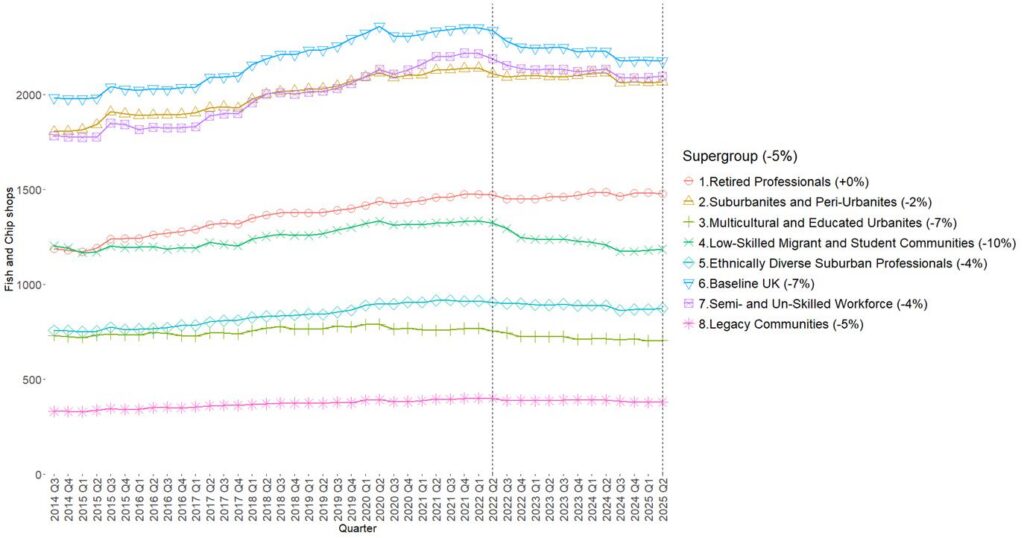
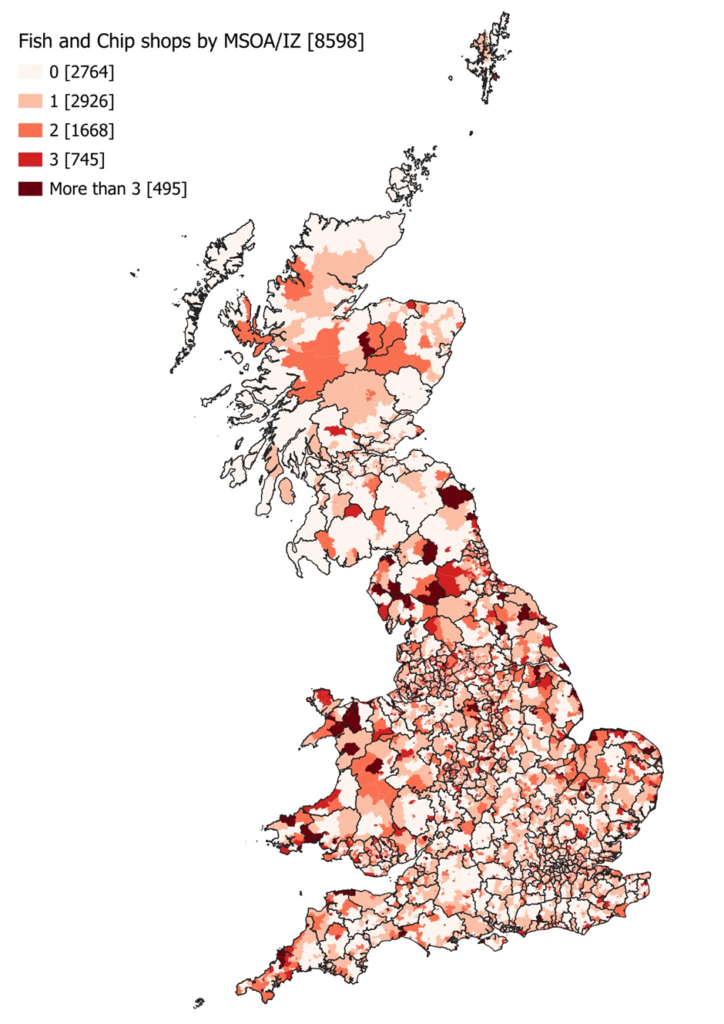
To set the context, the chart below shows the trend in the number of fish and chip shops by the geodemographic Supergroup, and the maps shows where they are located.
The Reality
From the peak numbers in late 2021 to the most recent quarter in this study, mid 2025, the number of fish and chip shops has reduced from approximately 11,600 to 11,000 (‑5.2%).
Over a slightly shorter 3-year time period, which is compatible with the Sarson’s time horizon, we see a modest -4.6% reduction in the overall number of fish and chip shops in Great Britain, an order of magnitude less than the advertised 1-year risk of 50% as reported by the Guardian.
Additionally, by using a multi-level statistical model we are also able to see how trends in the number of fish and chip shops varies by the type of neighbourhood, addressing the question “Are there types of neighbourhood where this reduction is actually closer to the quoted 50%?”
Coastal and industrial areas most affected
The neighbourhood types with the largest density of fish and chip shops are 6b.Legacy Industrial and Coastal Communities neighbourhoods, with on average 2.7 shops in such areas.
This is hardly surprising given the historic legacy of fish and chip shops operating in industrial areas of northern England and the West Midlands, and being a staple of the British sea side. However, these same neighbourhoods also show one of the largest reductions in our data, with on average one shop being lost annually for every 17 such neighbourhoods.
Two other neighbourhood types, 4c.Challenged Multicultural Communities and Students, and 4a.Ethnically Diverse Families in Less Connected Locations also shows similar levels of reduction, but from much lower starting levels than 6b.Legacy Industrial and Coastal Communities neighbourhoods. Indeed this Supergroup of 4.Low-Skilled Migrant and Student Communities appears to most impacted by fish and chip shop closures.
There is just one neighbourhood type that shows a significant increase, those areas that are the more affluent 1a.Spacious Rural Living, with one extra shop for every 59 such neighbourhoods.
Understanding the trends
It is undoubtedly the case that the main driver for the closure of fish and chip shops in Great Britain is economic pressures. The cost of ingredients has increased whilst the purchasing power of most households has diminished.
To remain viable, shops would need to increase their prices. However there are a number of constraints on this strategy. Firstly, there are competition effects, where owners may be reluctant to raise prices when there are competitor shops nearby that may attract their customers. This is probably the case for the 6b.Legacy Industrial and Coastal Communities neighbourhoods where there is the possibility of multiple alternative shops for customers to visit.
Secondly even where there is not so much competition, fish and chip shops may still not be able to raise prices, this time because their customers simply can no longer afford to pay the prices asked. In both situations however, the laws of economics still apply, and shops may just have to close if they cannot meet their running costs.
Other than costs there may be a move for fish and chip shops to diversify their menu beyond the staples of a fish and chip shop. This may be to reflect a desire to offer cheaper food options, or to reflect the changing population of the neighbourhood. Ultimately, they will no longer be recognisable as traditional fish and chip shops and, whilst still in business, be re-designated within the Points of Interest data set as the more generic fast food establishments.
A further incentive toward diversification may be linked to generational changes. Even though traditional fish and chips are a firm favourite dish, a recent study found that around six in ten of Gen Z and Millennials say they prefer alternative fish dishes to a traditional fish and chip supper. This may highlight this generational divide, and reflects in our finding for the 4.Low-Skilled Migrant and Student Communities Supergroup.

Our Verdict
Fish and chip shops remain under strain, but the data do not support claims that half could disappear within a year.
This unique study of the state of fish and chip shops in Great Britain has revealed that there are genuine challenges for fish and chip shops to remain as economically viable businesses which many in the community would want to retain and consider to be an asset.
However, the impact of these challenges are nowhere near the quoted risk in the Guardian article, which could be considered to be sensationalist, and rather undermines efforts to help the sector by cultivating the impression that ‘things aren’t so bad’ and thereby denying the sector the support it may need.